
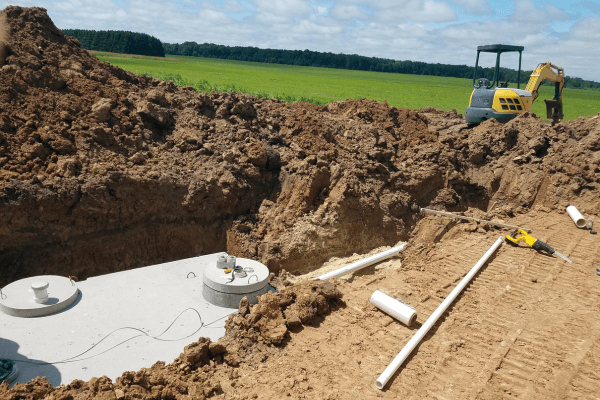
A septic tank is a watertight, underground tank that receives wastewater from a property not connected to the mains drainage system, separates solids from the water and carries out an initial treatment before the water seeps into the ground. It works without electricity: just using gravity and the bacteria that live inside it.
It is the standard solution in detached houses, country homes and scattered housing estates where the municipal sewerage network does not reach – a very common situation in the Marina Alta and La Safor. All the water used in the house (toilets, shower, kitchen and washing machine) ends up in it.
A septic tank does not treat the water completely. It carries out primary treatment: it retains solids and fats, and discharges clarified water which is then filtered through the ground. This is why solids build up over time and the tank needs to be emptied periodically.
Parts of a septic tank
Although from the outside it may just look like a cover in the garden, a septic tank consists of several parts, each of which serves a specific purpose.
|
Part |
What is it? |
What is it for? |
|---|---|---|
|
Inlet pipe |
The pipe coming from the house |
It carries all the household waste water to the septic tank |
|
Deposit |
A watertight, buried container comprising one or more chambers |
It retains the water long enough for the solids to separate |
|
Partitions or compartments |
Internal partitions within the tank |
They cause the water to flow from one chamber to another, so that it comes out cleaner |
|
Outlet pipe |
The pipe through which the clarified water flows |
It discharges water into the infiltration system without carrying away solids or grease |
|
Cover or lid |
The opening through which one enters the interior |
It allows the septic tank to be inspected and emptied using a tanker lorry |
|
Ventilation |
A gas outlet pipe |
It vents the gases produced inside |
|
Infiltration system |
A drainage ditch or soakaway, outside the septic tank |
Spread the water coming out of the pit over the ground so that it can finish filtering through |
The tank and the infiltration system work together: if one fails, the other is also affected. For example, if the septic tank is too full and allows solids to escape, these end up clogging the drainage trench or the infiltration pit. Two small components are of great importance: the inlet and outlet baffles, which we explain in the section on the function of inlet and outlet baffles, and the ventilation system, which we discuss in the section on septic tank ventilation systems.
How a septic tank works, step by step
A septic tank operates continuously and without intervention: every time water is used in the house, the incoming water pushes out the water that is already inside. The process consists of five stages.
- Entry. Wastewater from the house flows in through the inlet pipe. A baffle slows the water down so that it does not stir up what is already in the tank.
- Decanting. The water remains still long enough for heavy solids to settle at the bottom and for fats and light materials to rise to the surface.
- Digestion. At the bottom, anaerobic bacteria (those that live without oxygen) break down some of the organic matter. They reduce the volume of the sludge and produce gases, which are vented out.
- Exit. The clarified water remaining between the two layers passes into the next chamber, if there is one, and flows out through the outlet pipe. Another baffle prevents fats or solids from escaping.
- Infiltration. The water flows into the ditch or infiltration pit and spreads out across the ground, where it finishes filtering through.
Whatever the bacteria cannot break down remains in the tank. That is why sludge and scum build up until the septic tank has to be emptied by a tanker lorry. If you’d like to find out more about each stage, you can read more about the role of bacteria in septic tanks and where the water from a septic tank goes.
The three layers of a septic tank
If the manhole cover of an operational septic tank is opened, the contents are separated into three layers.
|
Cape |
Where is it? |
What’s inside |
What’s going on with her? |
|---|---|---|---|
|
Cream |
On the surface |
Fats, oils, soaps and lightweight materials |
They build up and are removed when the cesspit is emptied |
|
Clarified water |
In the middle |
Water with fewer solids and fats |
It flows out of the sump into the infiltration system |
|
Sludge |
Deep down |
Decomposing heavy solids |
The bacteria shrink in size; the rest are removed when the septic tank is emptied |
When the sludge and scum take up too much space, the layer of clarified water becomes thinner, the water does not have time to settle, and solids begin to seep into the ground. That is when it needs to be emptied.
Types of septic tanks
All septic tanks work in the same way, but they differ in terms of the material the tank is made of and the number of chambers.
According to the material
- Prefabricated from polyester or polyethylene. These are mass-produced tanks that are buried once they are complete. They are lightweight, watertight and easy to install. In Spain, prefabricated tanks must comply with the UNE-EN 12566-1 standard, which sets out the requirements for watertightness and strength.
- Brick or concrete. They are built on the site itself. They are common in older properties and, if the structure loses its watertightness over the years, untreated water may leak out.
Depending on the number of cameras
- From a camera. All the separation takes place in a single tank. It is the simplest design.
- With two or three cameras. The water flows from one chamber to the next through partitions. Most of the solids settle in the first chamber, and in the subsequent chambers the water emerges cleaner, meaning less dirt reaches the ground.
The right size depends on the number of people living in the house and how it is used, as we explain in the article on the optimal size of a septic tank.
Septic tanks, cesspits and sewage treatment plants: the differences
They are often used interchangeably, but they are three distinct systems. The difference lies in what they do with the water.
|
|
Cesspit or cesspool |
Septic tank |
Compact wastewater treatment plant |
|---|---|---|---|
|
What does it do? |
It collects wastewater and allows it to seep into the ground untreated |
It separates solids and fats and carries out primary treatment |
It provides a more comprehensive water treatment process |
|
Deposit |
It isn’t usually watertight |
Watertight |
Watertight |
|
Running water |
Untreated |
Once clarified, it finishes seeping into the ground |
Refined |
|
Electricity |
No |
No |
Usually, yes |
|
Current use |
Typical of older buildings |
The usual option for homes without a sewerage system |
When cleaner effluent is required |
The most significant difference is between a cesspit and a septic tank: a cesspit does not treat the water and, as it is not watertight, allows it to seep into the ground, which is why it is no longer considered a suitable solution. If your home has a cesspit, it is advisable to check with the local council before making any changes.
When choosing between a septic tank and a treatment plant, the decision depends on the property and the plot of land. We explain this in detail in ‘Septic tanks vs mini treatment plants: differences and when to choose each’.
How to look after a septic tank to ensure it works properly
A septic tank works on its own, but only if it is used properly and emptied in good time. Here are the key points, with a detailed guide for each one.
What goes into the pit. The bacteria in the septic tank can be damaged by harsh chemicals, and some waste never breaks down. Find out which products should never be poured into the septic tank and which are safe for a septic tank.
The pouring. Sludge and scum must be removed regularly using a tanker lorry. We explain when it’s time to empty your septic tank and what happens if you don’t empty it.
Warning signs. Odours, slow-draining pipes or puddles in the garden are signs that something is wrong. Read on to find out what the signs are that a septic tank needs urgent cleaning and what you can do to stop your septic tank from smelling.
The surroundings. The roots of some trees can damage the septic tank and the drainage trench, as we explain in our guide on which plants to avoid near a septic tank.
What do the regulations say about septic tanks?
In Spain, there is no single set of regulations governing all aspects of septic tanks: various authorities are involved, depending on the work being carried out.
- The tank. Prefabricated septic tanks must comply with the UNE-EN 12566-1 standard, which sets out the requirements for their watertightness and strength.
- Water discharged onto land. The consolidated text of the Water Act requires authorisation for discharges into the public water domain, which is granted by the river basin authority. In the Marina Alta and La Safor regions, this is the Júcar River Basin Authority.
- The installation. Building and location requirements vary from one local council to another.
Before installing, replacing or modifying a septic tank, check with your local council to find out what permits you need in your particular case.
Frequently asked questions about septic tanks
Does a septic tank treat the water completely?
No. It carries out primary treatment: it retains solids and fats and discharges clarified water, which is then filtered into the ground via a drainage ditch or soakaway. A sewage treatment plant is required for more comprehensive treatment.
Does a septic tank need electricity?
No. It works by gravity and thanks to the bacteria living inside it. The water flows in, settles and flows out without the need for pumps or motors, unless the layout of the land means the system has to lift the water.
What is the difference between a septic tank and a cesspit?
A septic tank is a watertight tank that separates solids and carries out an initial treatment of the water. A cesspit is not watertight and allows untreated waste water to seep into the ground.
Why do some septic tanks have several chambers?
Because the water comes out cleaner. Most of the solids settle in the first chamber and, as the water passes into the next one, it settles again, so that less dirt reaches the ground.
Does a septic tank fill up even if it’s working properly?
Yes. Bacteria reduce the volume of the sludge, but they do not eliminate it entirely. Sludge and scum build up gradually and, even if the septic tank is working properly, it needs to be emptied periodically.
A septic tank runs on its own, but it needs maintenance
A septic tank is a simple system: a watertight tank where water settles, bacteria break down some of the waste, and the clarified water is eventually filtered into the ground. The only thing it cannot do on its own is get rid of the sludge and scum that build up, which is why it needs to be emptied regularly.
At Limpiezas Domingo e Hijos, we carry out septic tank emptying using a tanker lorry in La Marina and La Safor.
Call us on 672 450 224 or 966 447 070, or request a quote.