
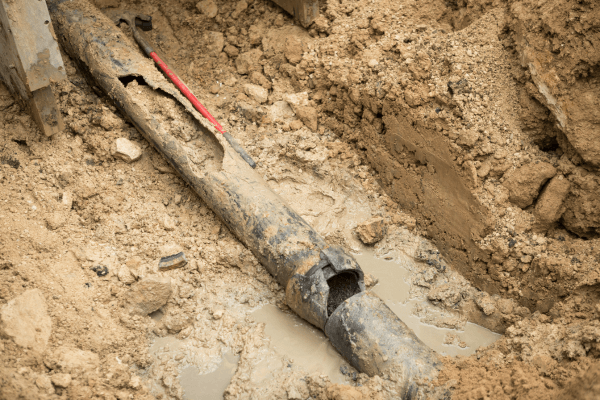
The clearest signs that a drainpipe is broken are a persistent sewer smell, damp patches with no visible cause, subsidence in the ground or garden, and blockages that keep returning even after they have been cleared. To confirm this and find out exactly where the break is, a camera inspection is required.
A burst drain pipe doesn’t usually give itself away straight away. It starts with a crack or a loose joint that lets dirty water seep out little by little: the problem grows beneath the floor or behind the wall, whilst at home you might only notice a strange smell or a drain that’s draining a bit more slowly.
The sooner it is detected, the easier and cheaper it is to repair. And if it is pinpointed accurately, in many cases it can be repaired from inside the pipe, without having to lift floors or dig trenches.
In this guide, we explain how to recognise the signs, how to tell the difference between a blocked drain and a drinking water leak, how to confirm the problem, and what options are available for repairing it.
7 signs that your drainpipe is broken
None of these signs on their own confirms a fault, but if you notice two or more at the same time, it is advisable to have the installation checked.
1. A persistent sewer smell
If there is a smell of sewage in the bathroom, kitchen, basement or garden, and the smell returns even after you’ve cleaned the drains, there may be a crack through which gases and dirty water are escaping. If the smell is coming from a single drain, first rule out a dry or dirty trap, as explained in our guide on how to remove bad smells from pipes.
2. Damp and stains with no apparent cause
Stains on walls, ceilings or floors near downpipes and drains, bulging paint or mould in areas where there are no visible water pipes. If the stain is on the ceiling beneath a bathroom, this is one of the clearest signs.
3. Subsidence or damp patches in the ground or garden
When an underground pipe leaks, the soil around it is washed away and settles. Signs include paving slabs that move or sound hollow, small potholes, puddles that won’t dry up, or a patch of lawn that is greener and grows more vigorously than the rest.
4. Traffic jams that keep happening again and again
A crack distorts the pipe and creates ridges where debris gets caught. If the same drain becomes blocked every few weeks, even though it clears easily, the problem may not be the dirt, but the pipe itself.
5. Slow-draining pipes in various parts of the house
If the water level drops slowly in several appliances at the same time, there may be a sagging or broken section in a shared pipe, through which the water is struggling to flow.
6. The sound of running water when nobody is using it
Gurgling or dripping sounds inside the walls or under the floor, particularly just after flushing the toilet, may indicate that water is leaking through a break rather than following its normal course.
7. Insects or rodents near drains
Cockroaches, drain flies or rats that appear for no apparent reason may be entering through a broken pipe, which provides them with a route from the sewerage system.
A blocked drain or a drinking water leak: how to tell the difference
A damp problem can originate from two different systems: the drinking water system, which supplies pressurised water to the taps, or the drainage system, which carries away used water by gravity. Knowing which one it is saves you time and money, as they are identified and repaired in different ways.
The simplest test is the water meter test: turn off all taps and appliances that use water and watch the meter for a few minutes. If it keeps turning, water is leaking from the drinking water system. If it doesn’t move, the problem is most likely in the drainage system.
|
What you notice |
Broken drain |
Drinking water leak |
|---|---|---|
|
Counter with everything closed |
It isn't moving |
Keep spinning |
|
Smell |
Into the drain |
None |
|
When does damp appear? |
After using toilets, showers or washbasins |
All the time |
|
Water bill |
It doesn’t change |
It goes up for no reason |
|
Other symptoms |
Blockages, slow-draining pipes, insects |
Lower water pressure from the taps |
If the meter is turning, you’ll need to locate the water leak; we explain how to do this in our guide on how to detect a water leak. If everything points to the drain, carry on reading.
Why does a drainpipe burst?
Drain pipe bursts are almost never sudden: they are the result of years of wear and tear or an external factor that gradually damages the pipe. The most common causes are:
- The age of the material. Fibre-cement or iron pipes deteriorate over time; in older buildings, it is common for downpipes to be cracked.
- The roots. They seek out damp, enter through the joints and end up splitting or displacing the pipework. We explain this in our guide on how to identify and fix root intrusion.
- Ground movements. Construction, nearby building works or vehicles driving over shallow pipes can cause a section to sink or break.
- A poor installation. Poorly sealed joints or incorrect slopes cause water to pool and always damage the same spot.
You can find all the causes – and how to prevent them – in our article on the common causes of burst pipes.
How to confirm and locate a blockage in the drain
The signs may raise suspicions, but only an inspection can confirm whether there is a break, exactly where it is and how serious it is. Without that information, any repair is a shot in the dark: the floor is lifted where the problem appears to be, and often it isn’t there.
Camera inspection
chamber and moved along the inside. At Limpiezas Domingo, we use pan-and-tilt cameras with 360° vision, which allow us to see:
- Cracks, fissures and breaks.
- Sections that have subsided or become distorted.
- Offset joints.
- Roots inside the pipe.
- Areas with an incorrect gradient where water pools.
Camera-based pipe inspection is carried out without causing any damage and reveals the actual condition of the pipe. If you’d like to find out more, we explain what problems can be detected during a camera inspection.
Exact location from the surface
Once the break has been identified, we need to find out exactly where it is in the house or garden. To do this, we trace the pipe’s route using detection equipment, including ultrasound devices, and mark the exact location on the ground. This is what we do as part of our pipe blockage and break detection service.
needed. And if we cannot find the manhole to insert the camera, we will also locate it using our hidden manhole detection service.
How to repair a broken drainpipe
There are two options: to open up and replace the damaged section, or to repair it from the inside without any building work. A preliminary inspection will determine which option is feasible.
Repairs without building work
If the pipe retains its shape, it can be repaired from the inside, accessing it via a manhole or inspection chamber, without having to lift floors, break through walls or dig trenches. At Limpiezas Domingo, we use three methods:
|
Method |
When to use it |
What is achieved |
|---|---|---|
|
Spot repair using a packer |
A crack or a damaged joint at a specific point |
Only the damaged section is sealed |
|
Internal resin coating |
Pipes showing signs of wear or cracks in several places |
The inside of the pipe is coated |
|
Continuous sleeve with LED curing |
Long sections or entire downpipes in a very poor state of repair |
A new pipe is laid inside the old one |
It is also suitable for downpipes in older buildings made of fibre cement, which can be refurbished from the inside without having to remove them. You can find all the details in our no-dig pipe repair service.
Repairs involving building work
If the pipe is crushed, cracked or displaced to such an extent that it cannot be lined from the inside, the section must be cut open and replaced. Even in that case, pinpointing the exact location of the break means that the pipe only needs to be cut open where necessary.
With or without building work: what changes
|
|
No building work |
Under construction |
|---|---|---|
|
Floors, walls and garden |
Unscathed |
They need to be lifted and replaced |
|
Rubble |
None |
Yes |
|
Trouble at home |
Lows |
Seniors |
|
When is it possible? |
If the pipe retains its shape |
Always, but it’s more invasive |
If you’d like to compare the two systems in more detail, we explain them in our section on traditional and trenchless methods for pipe repairs.
What to do if you suspect the drain is blocked
Pending the review, these steps will help to minimise the damage:
- Reduce the use of the affected drain. Every flush sends more dirty water through the leak.
- Make a note of what marks you get and when. If damp appears when using a particular bathroom or the smell comes from a specific spot, that information helps to pinpoint the leak sooner.
- Test the meter. This way, you can rule out the possibility of a drinking water leak.
- Do not pour chemicals down the drain. If the problem is a burst pipe, they won’t fix it and may cause further damage to an already weakened pipe; we explain this in our guide to common mistakes when trying to unblock pipes yourself.
- If you live in a flat, let the property manager know. If the leak is in a shared drainpipe, the repair is usually the responsibility of the residents’ association.
- Ask for a camera inspection. It’s the only way to find out if there’s a leak, where it is, and whether it can be repaired without any building work.
Frequently asked questions about burst drain pipes
How do I know if the drain is broken or just blocked?
If, once the blockage has been cleared, the water drains away properly again and the problem does not recur, it was a blockage. If the blockage keeps coming back, or is accompanied by damp, odours or subsidence, there may be a burst pipe. A CCTV inspection will confirm this.
Can a drainpipe be repaired without breaking the floor?
Yes, provided the pipe retains its shape. It can be repaired from the inside using methods such as spot repair with a packer, resin lining or a continuous sleeve with LED curing. First, the break must be located to confirm that the repair is feasible.
Is it possible to locate a burst in an underground pipe?
Yes. The pipe is inspected from the inside using a camera, and its route is traced from the surface using detection equipment, so that the exact location of the break can be marked on the ground without having to dig blindly.
How can I tell the difference between a burst drain and a drinking water leak?
Turn off all the taps and check the meter. If it keeps turning, the leak is in the drinking water system. If it doesn’t move and there’s a smell of sewage or damp when you use the toilets, the problem is in the drainage system.
Can a broken drainpipe cause damp on the floor below?
Yes. It is one of the most common causes of stains on the ceiling beneath a bathroom. Dirty water leaking from the downpipe soaks the floor structure and appears as damp in the flat below.
Find the fault before you break anything
A burst drain gives warning signs such as unpleasant odours, damp, subsidence or blockages that won’t clear. The sooner it is checked, the less damage it causes to the property. And if the break is pinpointed accurately, it can often be repaired from the inside, without the need for building work.
At Limpiezas Domingo e Hijos, we take care of the whole process for you:
- Camera inspection to assess the actual condition of the pipework.
- Exact location of the break as seen from the surface.
- Repair without the need for building work where the pipework allows it, or a localised repair where it does not.
We have over 15 years’ experience and operate in La Marina and La Safor. We have dedicated pages for non-invasive pipe repairs in the Marina Alta and La Safor.
Call us on 672 450 224 or 966 447 070, or request a quote.