
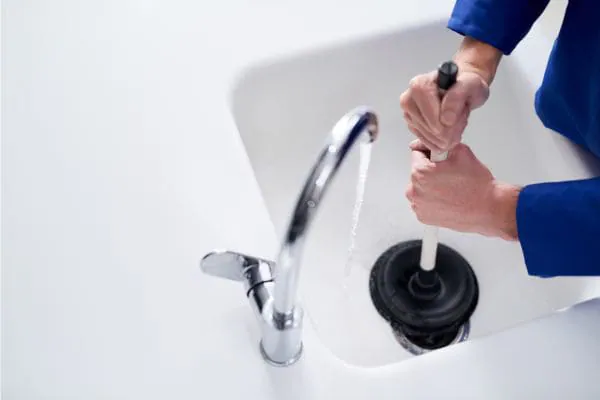
When should you call a drain clearance professional?
You can sort it out yourself if the blockage affects just one drain and can be cleared using a plunger or by cleaning the trap. It’s best to call in a professional if the blockage returns, affects several drains, is in a manhole, a downpipe or the main sewer system, if there is damp or odours suggesting a burst pipe, or after two unsuccessful attempts.
The difference isn’t how serious the blockage appears to be, but where it is. Household tools can only reach the first few centimetres of the pipe; if the blockage is further in, carrying on trying just wastes time and, sometimes, makes the problem worse.
In this guide, we explain what you can do yourself and to what extent, when it’s worth calling out a professional, what a professional can offer, and how to choose a drain-clearing company.
What you can do (and how far it goes)
Most blockages in a single drain can be cleared using three simple tools:
- The suction cup. It works in toilets, sinks, washbasins and showers when the plug is nearby, in the bowl or in the trap.
- Clean the trap. In sinks and washbasins, taking it apart and emptying it clears up many blockages caused by grease, hair and food scraps.
- The manual unblocking spring. It reaches a little further than the siphon and allows you to break up or remove nearby blockages.
The limit is determined by how far they can reach from the drain itself: a few metres of pipework. If the blockage is in the building’s downpipe, in a garden manhole or in the main sewer, they cannot reach it.
You’ll find specific steps for each appliance in the guides on toilets that keep getting blocked, sinks that get blocked time and time again, and showers that drain slowly, as well as general methods for unblocking pipes.
7 situations when it’s best to call in a professional
In these situations, the problem is beyond the scope of the tools you have at home, or carrying on trying could prove costly.
1. The traffic jam keeps coming back
If the same drain becomes blocked every few weeks, there is something inside the pipe causing the blockage: built-up grease, limescale, roots or a damaged section. Unblocking it again merely alleviates the symptom.
2. Several drains become blocked at the same time
When the toilet, shower and washbasin all stop working at the same time, the blockage is in a shared pipe – the downpipe or the house’s drainage system – rather than in any specific fixture.
3. Water is backing up through another drain
If water comes out of the shower when you flush the toilet, or if water backs up into the sink when you run the washing machine, the blockage is in a shared section of the pipework. We’ll explain why water backs up through the drain.
4. The problem is in a drain chamber or the downpipe
Overflowing manholes or blocked downpipes require equipment that uses pressure and suction from the outside. For more information, see ‘blocked manhole’ and ‘blocked downpipe’.
5. There is damp, odours or subsidence
If the blockage is accompanied by damp patches, a persistent sewer smell or the floor giving way, there may be a burst pipe. We’ll help you identify it in our guide on how to tell if a drainpipe has burst.
6. The house has a septic tank
If all the drains are running slowly in a property with a septic tank, it is most likely that the tank needs emptying. We explain how to tell when this is the case and how often a septic tank needs emptying.
7. You’ve already tried twice without success
If the plunger and the siphon haven’t worked after a couple of attempts, the blockage is further down the pipe. Applying more force or using chemical products may damage the plumbing.
You or a professional? A summary in a table
|
Situation |
Who |
Why |
|---|---|---|
|
A single drain that is slow or blocked for the first time |
You |
The blockage is usually in the trap or nearby |
|
A blockage that can be cleared using a plunger or by cleaning the trap |
You |
Sorted; make sure he doesn’t come back |
|
The same traffic jam occurs every few weeks |
Professional |
There is a blockage inside the pipe |
|
Several blocked drains at the same time |
Professional |
The blockage is in a shared section |
|
Water is coming up through another drain |
Professional |
Blockage in a shared pipe |
|
Overflowing drain or blocked downpipe |
Professional |
Pressure and suction are required |
|
Damp, a sewer smell or subsidence |
Professional |
Possible break; it needs to be located |
|
All the slow-draining pipes in a house with a septic tank |
Professional |
The septic tank probably needs emptying |
|
Two unsuccessful attempts |
Professional |
The stopper is out of your reach |
What might happen if you keep trying on your own
Persisting when the traffic jam is beyond your control not only fails to solve the problem: it can make it worse.
- Push the stopper in further. Using a spring or improvised objects, the blockage can be pushed further into a harder-to-reach spot.
- Damage to joints and pipes. damage the joints, particularly in older pipes.
- Allowing chemicals to stand. If they don’t reach the plug, they’ll get stuck in the pipe or in the sink, and whoever comes after will have to deal with them.
- Delaying diagnosis. Meanwhile, a potential rupture or a full septic tank continues to get worse.
We explain these problems in more detail in the section on common mistakes when trying to unblock pipes yourself.
What can a professional offer that you cannot do yourself?
The difference lies in the equipment and the diagnosis. A professional doesn’t just remove the blockage: they find out why it has formed.
- It reaches places you can’t. Using a tanker lorry and pressurised water, it cleans downpipes, manholes and main pipes, and sucks up the sludge.
- It cleans the entire pipe, not just the blockage. High-pressure cleaning removes grease, limescale and stubborn deposits, reducing the likelihood of the blockage returning.
- Take a look inside the pipe. A camera inspection reveals roots, breaks or sections that have collapsed, without breaking anything.
- Pinpoint the exact location. The location of blockages and breaks is marked on the floor to show where the problem is.
- Carry out repairs without the need for building work wherever possible. If there is a burst pipe, repairing it without the need for building work avoids the need to lift floors and walls.
- Prevent problems in businesses and communities. Pipe maintenance contracts schedule cleaning services for communities, businesses, housing estates and property managers experiencing frequent issues.
How to choose a drain-clearing company
Not all companies operate in the same way. Before taking on staff, it is worth asking about the following points:
|
What to ask |
Why it matters |
Limpiezas Domingo |
|---|---|---|
|
Do you use a tanker lorry and pressurised water? |
Without it, downpipes, manholes and long sections cannot be cleaned properly |
Yes |
|
Do you carry out a camera inspection if the blockage returns? |
Without a diagnosis, the congestion recurs |
Yes, with 360° cameras |
|
Can you sort it out without any building work? |
Avoid lifting floors and walls |
In most cases, repair work is only considered if there is structural damage |
|
How do you set the price? |
Avoid any surprises on your bill |
A budget tailored to the actual scope of the work |
|
What do you do with your waste? |
Wastewater and sludge must be managed in accordance with the regulations |
They are managed in accordance with current regulations |
|
Do you treat emergencies? |
Some traffic jams can’t wait |
Yes, with an express and 24-hour service, subject to availability |
|
Do you know the area? |
Local experience helps you get to know the usual facilities |
Over 15 years in La Marina and La Safor |
Frequently asked questions about when to call a professional
A plumber or a drain-clearing company?
It depends on the problem. For taps, cisterns or plumbing systems, a plumber. For blockages in downpipes, manholes, main pipes or septic tanks, a drain-clearing company with a vacuum truck, high-pressure water and an inspection camera.
How many times should I try before I ring?
If, after a couple of attempts with the plunger and cleaning the trap, the water still hasn’t drained away, the blockage is out of your reach. Trying harder usually makes the problem worse.
Can a professional prevent the blockage from recurring?
In most cases, yes. Pressure washing the entire pipe removes any build-up, and if the blockage returns, a CCTV inspection can identify the cause: roots, a break or a section that has subsided.
Is it worth checking the pipes if there’s no blockage?
It may be worth it if the house is quite old, if several drains are running a bit slowly, or if the drainage system has never been cleaned. A timely inspection prevents a partial blockage from turning into a complete blockage.
Do residents’ associations need professional maintenance?
In communities with shared drainpipes and frequent problems, it is definitely worth it. A maintenance contract schedules preventative cleaning so that blockages do not end up affecting residents.
If the blockage isn’t in just one drain, please call
A one-off blockage in a drain can be cleared at home using a plunger or by cleaning the trap. But if it recurs, affects several drains, is in a manhole or a downpipe, or if damp and odours appear, the problem is beyond your control and carrying on trying will only make it worse.
pressure water, inspect the pipes with a camera to identify the cause and, if there is a break, repair it without the need for building work where possible. We operate in La Marina and La Safor, with over 15 years’ experience.
Call us on 672 450 224 or 966 447 070, or request a quote.