
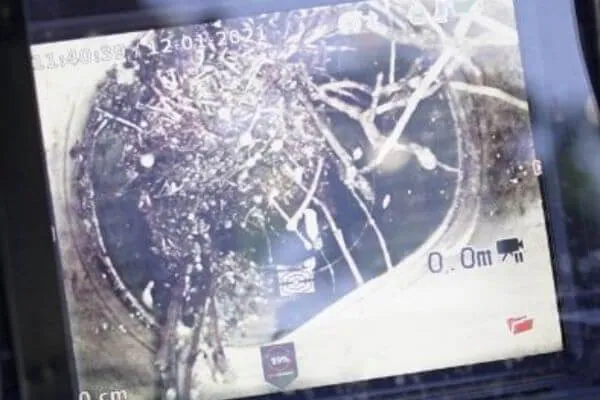
What is a pipe inspection with a TV unit?
A TV unit inspection involves inserting a camera into the pipe to view and record its interior in real time, without building work. It pinpoints blockages, breaks, roots or structural damage and shows exactly where they are, so that work is done only at that point.
It is the first step of any well-done repair: instead of guessing what is wrong with the pipe, it is checked. It is used in homes, residential communities, businesses and public or private sewer networks.
In this guide we explain how the equipment works, how an inspection is carried out, what problems it detects and what you receive at the end.
How a TV inspection unit works
A TV inspection unit has three parts that work together:
- Camera: it goes into the pipe and transmits the image outside. There are manual cameras, which are pushed along with a semi-rigid cable, and robotic cameras, which move on their own through larger-diameter pipes.
- Self-levelling head: it keeps the image upright even when the camera rotates, so that what is seen can be interpreted correctly.
- Distance meter and radio-frequency transmitter: they show how many metres the camera has travelled and make it possible to locate from the surface the exact point where the head is.
At Limpiezas Domingo we work with manual and robotic cameras designed to inspect drainage networks, public or private sewers, stormwater networks and all types of pipes.
How a camera inspection is carried out, step by step
1. Access to the pipe
The camera is inserted through a manhole, an access point or a drain. If there is no access because the manhole is covered, the hidden manhole must be located first.
2. Survey and recording
The technician moves along the pipe while watching the image on the monitor and recording it, noting the distance of each incident.
3. Location on the surface
When a problem appears, the camera head is located from above and the spot is marked on the ground. That way, if it has to be opened or repaired, the work is done exactly there.
4. Report and video
At the end, a detailed report is produced with the recording of the inspection. This report is solid evidence for submitting claims to insurance companies.
What problems a TV unit inspection detects
- Blockages and build-up of grease, limescale or waste.
- Cracks, fissures and breaks.
- Roots that have entered the pipe.
- Subsidence, deformations and displaced joints.
- Sections with the wrong slope.
- Foreign bodies and damage affecting watertightness.
Each one is explained in detail in what problems a camera pipe inspection can detect.
When it is worth inspecting a pipe with a camera
- Blockages that come back even after unblocking.
- Persistent bad smells, gurgling or slow drainage.
- Damp or leaks near the pipe route.
- Before a repair, to choose the right technique and confirm whether it can be done without building work.
- As a preventive check in old buildings or heavily used installations.
- To document an incident for the insurance company.
In serious blockages, the camera makes the difference between a lasting solution and a patch: we explain why in why camera inspection is so important in severe blockages.
Advantages of TV unit inspection
- Non-invasive: nothing is broken to see the inside.
- Precise: you know what the problem is and how many metres away it is.
- Saves building work: if something has to be opened, only the exact spot is opened.
- Leaves a record: the video and report help you decide and support claims.
Frequently asked questions about TV unit inspection
What is a TV unit for pipes?
It is inspection equipment made up of a camera that is inserted into the pipe, a cable or drive system and a monitor on which the technician watches and records the inside of the pipe in real time.
Is building work needed to inspect a pipe with a camera?
No. The camera goes in through a manhole, an access point or a drain, without breaking floors, walls or gardens.
What problems can a TV unit inspection detect?
Blockages, build-up of waste, roots, cracks, breaks, subsidence, deformations, displaced joints and foreign bodies inside the pipe.
How do you know where the problem is from the surface?
The camera head measures the distance travelled inside the pipe and carries a radio-frequency transmitter that allows the exact point of the fault to be located from the surface.
Do you receive a report after the inspection?
Yes. After the inspection a detailed report is produced together with the video recording, which helps to decide on the solution and serves as evidence for an insurance company.
Before repairing, look inside the pipe
A camera inspection tells you what is wrong with the pipe, where it is and how it can be fixed, without breaking anything.
At Limpiezas Domingo e Hijos we have been working on drainage networks for more than 15 years in the Marina Alta and La Safor, from Benidorm to Gandía. We inspect pipes and drainage networks with manual and robotic cameras and provide a report and video. More information on our pipe inspection with camera and domestic pipe inspection service pages.
Call us on 672 450 224 or 966 447 070, or request a quote.