
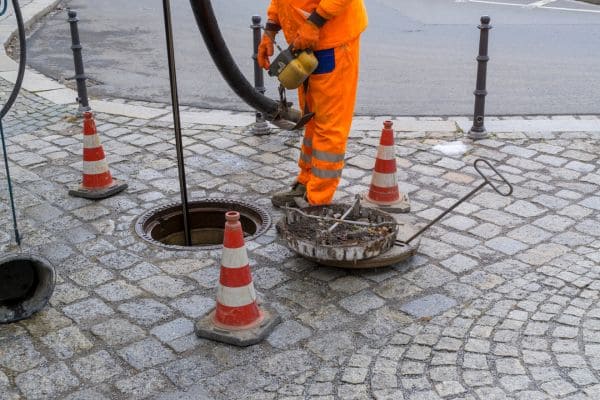
What technologies are used today to clean and repair pipes?
Nowadays, sewer pipes are treated using three main categories of technology: cleaning using vacuum trucks, high-pressure water jetting and pipe milling; diagnosis using inspection cameras and location equipment; and non-invasive repairs carried out from inside the pipe using packers, resin or LED-cured liners. When used in combination, they enable the majority of blockages and breaks to be cleared without lifting floors or digging trenches.
Until not so long ago, a persistent blockage or a hidden burst pipe meant digging blindly until the problem was found. Now it is possible to see inside the pipe, pinpoint exactly where the damage is and repair it by accessing it via a manhole.
In this guide, we explain what each technology does, what problems it is designed to tackle, and how they are combined in a real-world application. These are the technologies we use every day at Limpiezas Domingo e Hijos.
Cleaning technologies: removing blockages from pipes
Tank lorry with pressurised water and suction capabilities
It is the main tool for unblocking drains. A tanker lorry has two compartments: one containing clean water, which is injected under pressure into the pipe, and another where the waste that is sucked out is collected. The pressure breaks up the blockage and flushes out the debris, whilst the suction removes sludge and solids, even when a manhole has overflowed. We’ll explain why variable pressure makes all the difference when it comes to the advantages of variable-pressure tanker lorries.
Used for: blockages in pipes, downpipes, manholes and sewers. It forms the basis of our drain unblocking and pipe cleaning service.
High-pressure cleaning of the entire pipework
Clearing a blockage is not the same as cleaning the entire pipe. With high-pressure cleaning, the water flows through the entire length of the pipe and dislodges the grease, sludge, limescale and sediment stuck to the walls, so that the pipe regains its full cross-section.
Suitable for: recurring blockages, greasy kitchen drains and preventative maintenance.
Pipe milling
When the build-up inside is so firmly stuck that water cannot dislodge it, pipe milling is used, which works from inside the pipe using specialised equipment. Pipe milling removes scale, roots, cement, limescale and other adhering debris.
Suitable for: hardened limescale, building debris such as cement, and roots inside the pipe.
Diagnostic technologies: seeing what’s going on inside without breaking anything
CCTV inspection cameras
A camera is inserted into the pipe from a manhole or inspection chamber and travels along the inside of it. Oscillating-rotating cameras allow the view to be rotated through 360° and enable every joint and every wall to be inspected. This reveals cracks, breaks, roots, sections that have subsided, displaced joints or build-up that may be causing a recurring blockage.
It is used for: recurring blockages, suspected pipe breaks, before buying a property or before any repairs. This is the CCTV pipe inspection service, and for homes, the domestic pipe inspection service. We explain what can be detected and what problems can be identified during a CCTV inspection.
Tracking from the surface
It is not enough to see the problem from the inside: you need to know exactly where it is in the ground. Using detection equipment, including ultrasound, the pipe’s route is traced and the exact location of the blockage or break is marked on the surface.
It is used to: open up only where necessary, or to confirm that a repair can be carried out without opening the pipe. It is a service for locating blockages and breaks in pipes.
Detection of hidden manholes
Often, access to the mains is blocked by paving slabs, earth or building work. Without a manhole, there’s no way to get the camera or the hose in, so the first step is to find it.
Ideal for: renovated houses, gardens and garages where nobody knows where the manhole is. This is a service for locating hidden manholes.
Non-invasive repair technologies: repairing pipes from the inside
If the pipe is damaged but retains its shape, it can be repaired from the inside by accessing it via a manhole or inspection chamber, without having to lift floors, break through walls or dig trenches. An inspection is always carried out beforehand to confirm that this is feasible.
Spot repair using a packer
A device is inserted into the damaged section, which positions and presses a patch against the inside wall of the pipe until it is secured in place.
Intended for: a crack or a damaged joint at a specific point.
Internal resin coating
The inside wall of the pipe is coated with resin, which seals any cracks and areas of wear along the length of the pipe.
Suitable for: pipes with cracks or wear and tear in various areas.
Continuous sleeve with LED curing
A resin-impregnated sleeve is inserted along the entire length of the section and cured using LED light. The result is a new pipe inside the old one, with no joints through which it can leak. It is one of the variants of the CIPP technique, which we explain in our article on what CIPP stands for.
Suitable for: long sections and complete downpipes, including fibre-cement downpipes in older buildings, which are refurbished from the inside without having to remove them.
All these techniques form part of the trenchless pipe repair service. If you’d like to compare them with traditional repair methods, you can find them under ‘traditional and trenchless methods for pipe repair’.
What technology is required for each problem?
|
Problem |
Technology |
Service |
|---|---|---|
|
A temporary blockage in a drain, downpipe or manhole |
Tank lorry with pressurised water and suction capabilities |
Unblocking and pipe cleaning |
|
A traffic jam that recurs every few weeks |
High-pressure cleaning and, if the problem persists, an inspection chamber |
High-pressure cleaning and camera inspection |
|
Lime, cement or hard deposits |
Milling |
Pipe milling |
|
Roots inside the pipe |
A camera to detect them and milling to remove them |
Root infiltration |
|
Suspected damage (odours, damp, subsidence) |
Surface-based inspection and location camera |
Location of clogs and breaks |
|
The manhole cannot be found |
Manhole detection |
Detection of hidden manholes |
|
A crack or damaged joint in one place |
Packer |
Repairs without building work |
|
A long section of pipe or downpipe in a state of disrepair |
Continuous sleeve with LED curing |
Repairs without building work |
If you have roots in the pipework, the specific service required is root intrusion clearance.
How they are combined in an intervention
Technologies are not used in isolation: each one addresses a specific stage. This is typically how a repair job is carried out for a recurring blockage in a property:
- Access. Locate the manhole or inspection chamber; if it is concealed, use manhole detection equipment to find it.
- Cleaning. The tanker truck clears the blockage using pressurised water and sucks up the sludge to restore the passage.
- Diagnosis. With the pipe now clear, the camera is run through it to see why it was blocked.
- Location. If the camera detects a break, its exact position is marked from the surface.
- Solution. Depending on what is found: milling if there is lime or roots; a repair without excavation if there is a break and the pipe allows it; or a maintenance plan if the problem is a build-up.
Order matters: inspecting a pipe full of dirt means you can’t see a thing, and carrying out repairs without having located the damage is like working in the dark.
Frequently asked questions about pipework technologies
What is the difference between unblocking a pipe and pressure-washing it?
Unblocking clears the blockage so that the water can flow again. High-pressure cleaning runs the entire length of the pipe and removes grease, sludge, limescale and sediment from the walls, thereby reducing the likelihood of the blockage returning.
What is pipe milling used for?
To remove what high-pressure water cannot dislodge: limescale build-up, cement residue, roots and debris that is firmly stuck to the inside of the pipe.
Does a camera inspection mean you have to break anything?
No. The camera is inserted through a manhole or inspection chamber and travels along the inside of the pipe. All you need to do is find an access point; if it is hidden, it is located first.
What is a swivel-and-rotate inspection camera?
It is a camera whose head can rotate and swivel inside the pipe, providing a 360° view and allowing every joint and every wall to be inspected, not just what lies ahead.
Can fibre-cement downpipes be repaired without removing them?
Yes. In many older buildings, the downpipes are made of fibre cement, and using the continuous sleeve technique, a new pipe can be fitted inside them without having to dismantle them.
The right technology prevents unnecessary building work
With vacuum trucks, high-pressure cleaning, milling, inspection cameras, and non-invasive detection and repair techniques, most blockages and breaks can now be resolved without having to dig up the ground. The key is to use each technology at the right stage: clean, inspect, locate and, only then, repair.
At Limpiezas Domingo e Hijos, we work with all of them in La Marina and La Safor, with over 15 years’ experience. Tell us what the problem is and we’ll tell you what your pipework needs.
Call us on 672 450 224 or 966 447 070, or request a quote.